Monday, July 9, 2012

Examining the Walking Stick


The other day Donna and I went for a walk and I dutifully grabbed my walking stick. A few steps out the front door she asked me why I always walked with a walking stick – even in town. It’s a great question that honestly has a lot of answers. Somewhere along the way, carrying a walking stick became instinctive and I had never really thought about why. So today I want to examine the walking stick – what they’re for, what they represent, and numerous reasons why you can and should carry a walking stick on your journey down the path of life.

My first memories of using a walking stick were when we would go for hikes as a child on the Bee House Creek back in Texas. My dad almost always carried a walking stick. He would usually find one laying on the ground somewhere and break it down to the perfect size. When we were done he would simply discard the stick, with it having served it’s purpose.
           
Those impressions stick with you (no pun intended), so I have carried on that tradition. To begin with, using a walking stick is very practical. Obviously, it’s a point of balance. It steadies you while stepping over rough terrain, curbs, ditches, railroad tracks, etc. If you walk at night, it’s easy to miss impediments that might trip you up were you not steadied with a walking stick.
           
Walking sticks are also great for poking at things. The list of poke-able items is endless: cobwebs, mud puddles, unidentified objects, tree limbs, rocks, snakes, fish, plants, ant piles, etc. Just the other day, as an example, Hart and I happened upon a possum lying in the road. I couldn’t tell if it was actually dead or just playing possum. A few healthy pokes with my walking stick - and then a complete flip of the possum - revealed it was dead. Stiff as a board. This is not something I would do with my bare hands but the walking stick was the perfect tool for it.
           
Walking sticks are also great self-defense weapons. If you carry a sturdy stick that’s five or six feet long, you could easily swat a menacing person from that far away. If you don’t think that’s an effective self-defense, try letting one of your friends whack you in the side of the head with a giant stick and see how it feels. It’s very effective. I have never been accosted by someone meaning to harm me - but I have had a menacing dog circle around me while walking at night here in our neighborhood. It’s reassuring to have that solid walking stick in your hand because the thought of fending off a dog or mugger bare handed is not very appealing.
           
Wikipedia also has a pretty thorough description of walking sticks:

Walking sticks, also known as trekking poles, pilgrim's staffs, hiking poles or hiking sticks, are used by hikers for a wide variety of purposes: to clear spider webs, or part thick bushes or grass obscuring the trail; as a support when going uphill or a brake when going downhill; as a balance point when crossing streams, swamps or other rough terrain; to feel for obstacles in the path; to test mud and puddles for depth; and as a defence against wild animals. A walking stick can be improvised from nearby felled wood. More ornate sticks are made for avid hikers, and are often adorned with small trinkets or medallions depicting "conquered" territory. Wood walking sticks are used for outdoor sports, healthy upper body exercise and even club, department and family memorials. They can be individually handcrafted from a number of woods, and may be personalized in many ways for the owner.

Aside from the practicality of walking sticks, they also have symbolic meaning. I have heard of stories of people crafting walking sticks with symbols, names, or dates, to commemorate the death of a loved one or celebrate a meaningful event in their lives.

The stick I use (seen here) comes from the Red River.


On the Red River here in Shreveport is a series of jetties. In the pockets formed by these jetties on the upriver side close to the bank, debris always piles up. After a flood, these piles of debris stay there, and the water softens the bark and after a time the bark falls off leaving the bare exposed wood. Usually in these debris piles you can pick and choose the perfect walking stick - as there are many to choose from. This particular stick still has teeth marks on it from whatever creature was gnawing on it when it fell.


I brought it home and sanded it, drilled a small hole in it in case I ever want to add some adornments. I also used a wood plane to shave off the knots to make it uniformly smooth. Now I have a pretty descent walking stick that I try to take with me every time I walk. 

Many famous people throughout history have used walking sticks. Just off the top of my head there's: 

Johnny Appleseed 


Notice the bunnies admiring the walking stick. 

Ben Franklin

Ben Franklin reading about walking sticks


Dr. Watson (of Sherlock Holmes fame)

Dr. Watson with his fancy walking stick. 
And of course Moses

Moses parting the Red Sea with his walking stick. 

When it comes to walking sticks you are only limited by your imagination. When you pick up a walking stick, remember you're carrying on a tradition that dates all the way back to biblical times. Next time you go for a hike just make sure you take a walking stick - the world’s first multi-tool.

Thanks for reading....Until next time! 

Thursday, May 24, 2012

How to Make Strawberry Leaf Tea/Tisane


The first thing you should know about tea will blow the teapot lid right off everything you thought you knew about tea. As it turns out, a drink can only be called tea if it’s made from the actual tea plant, Camellia sinensis. Every other drink that’s labeled as “tea” should technically be called “tisane.” For the sake of accuracy, today I am going to show you how to make strawberry tisane. But - for the sake of simplicity - I will erroneously continue to refer to it as strawberry tea.

I first got the idea to make some homemade tea from my garden. I planted some mint that Donna and I would use every now and then in our store bought tea to flavor it a little. Pondering how hard it was to make your own tea, I did some research on the Internet for easy to make tea recipes. More than once, I stumbled across recipes for Strawberry Leaf Tea.

I should warn you first about how I use the Internet. The Internet has no filter for erroneous information. I consider this one of its worst attributes. Any thought, idea, or story can be disseminated even if its 100% false. What I do when I find something I want to try is I see if I can find it referenced, mentioned, or talked about in more than one reputable website. I will leave it up to you to discern if a source is reputable, but for the most part if I can reach a consensus across a broad swath of sources, then I assume something is at least partially true.

Such was the case with Strawberry Leaf Tea.

Making Strawberry Leaf Tea is very, very simple. First you look at your strawberry plant. (I have one growing in my garden.) You find the biggest, cleanest leaves and pick them. It’s very important to inspect the leaves for blemishes, bugs, fungi, or any inconsistencies in the leaves. You want them to be green and pristine.

Strawberry leaves

This next part is VERY important. There are only two ways to consume strawberry leaves: completely fresh OR completely dry. There is no in-between. The in-between stage is dangerous because as a leaf decays there’s actually a chemical decomposition occurring and it is not healthy to consume these leaves. The easiest, which I used, was to pick them straight off the plant and use them immediately. (Some people like to dry them and save them for later.) I also picked some mint leaves and threw them in the pile to add a little flavor. 

Mint leaves

Once you have picked your clean, pristine strawberry leaves, wash them and place them in the bottom of your mug.  Bring a pot of water almost to boil and then pour the hot water onto the tea leaves. (I read from one source that boiling water will actually cook them leaves more than you want.) Let it steep for ten minutes. To create a sweeter flavor, you can add honey, sugar, or Splenda. Donna took hers with Splenda and I took mine the same with a small bit of honey.


Letting the leaves steep for ten minutes

As is the case with any raw plant you consume, I was afraid the taste would be peculiar. I brought in Donna to be my guinea pig. When it comes to tea, Donna is a woman of discriminating tastes so I knew if it got her seal of approval then Strawberry Leaf Tea was a legitimate contender. As you can tell from these before and after photos (which I should note were NOT staged) the Strawberry Leaf Tea tasted darn good! 


Beyond the great taste, Strawberry Leaf Tea is incredibly healthy. According to www.livestrong.com, Strawberry Leaf Tea promotes digestive health, helps alleviate arthritis, and contains many healthy nutrients such as iron, calcium, and Vitamin C.  

While my strawberry plant isn’t the most prolific strawberry producer, it is quite good at producing leaves - a nice consolation now that I know how to make Strawberry Leaf Tea! 

How to Start a Garden with Laughably Little Knowledge About Gardening


I know absolutely nothing about gardening.

Nothing.

And throughout my life, having little or no knowledge about something has always irked me – and motivated me. It was this combination of curiosity and frustration that has led to start learning about many things. This desire to rid myself of ignorance pushed me to learn how to play the piano, golf, make a documentary, be an actor, learn carpentry, play the guitar, drive a backhoe, pull a trailer, ride a horse, raise chickens, use a sextant, fly an airplane, and the list goes on. I love diving into new things. It’s why I pick up new instruments. It’s why I read books. I’m obsessed with accumulating knowledge. Right now I have a very long list of things I’m learning about or am going to learn about - among them sailing, scuba diving, botany, and cooking.

And, of course, gardening. Like I said, I know NOTHING about gardening.

In theory, gardening is one of the most basic of human endeavors –again, in theory. Somewhere long ago mankind figured out that instead of just gathering wild fruits and vegetables, they could manipulate their growth in a controlled environment and have better and more predictable results. This was the birth of gardening.

But any person who has gardened their whole life will tell you it’s not simple. At all. Gardening is an art. It has nuances, and generalities, and specifics. There is a flow to it as well as a predictable unpredictability. It takes a lifetime of accumulated knowledge to become truly great at gardening. Keeping these caveats in mind I decided this year to embark on a gardening adventure, aiming at best to be a mediocre gardener. 

The first step was to clear a spot. The woman who owned the house before made this easy. She already had a garden, so all I had to do was clear it out. I did it all by hand because any obese man smoking a cigarette and drinking a beer can go rent a tiller. I wanted to challenge myself. It took a couple of weeks of intense labor but I finally got the garden cleared. In my limited knowledge, the soil appeared to be healthy soil, full of nutrients and the garden sat in full sunlight for about six hours a day. 

As I prepared the garden, I was constantly referencing charts, tables, and YouTube videos. From what I gathered, you want to plant after the last frost of the year. In the south, this usually falls in early March or so. I finally picked a day and went to Lowe’s and arbitrarily picked some fruits and vegetables to put in my garden. The next morning I went to work planting the plants according to the spacing recommendations on the packaging.

That was my first mistake. Whatever the spacing recommendation is on the package, in my opinion, should be doubled. I will explain why later. I planted tomatoes, watermelon, potatoes, mint, onions, cucumbers, green peppers, strawberries, carrots, okra, and lettuce. I stepped back and admired my new garden. So far so good.

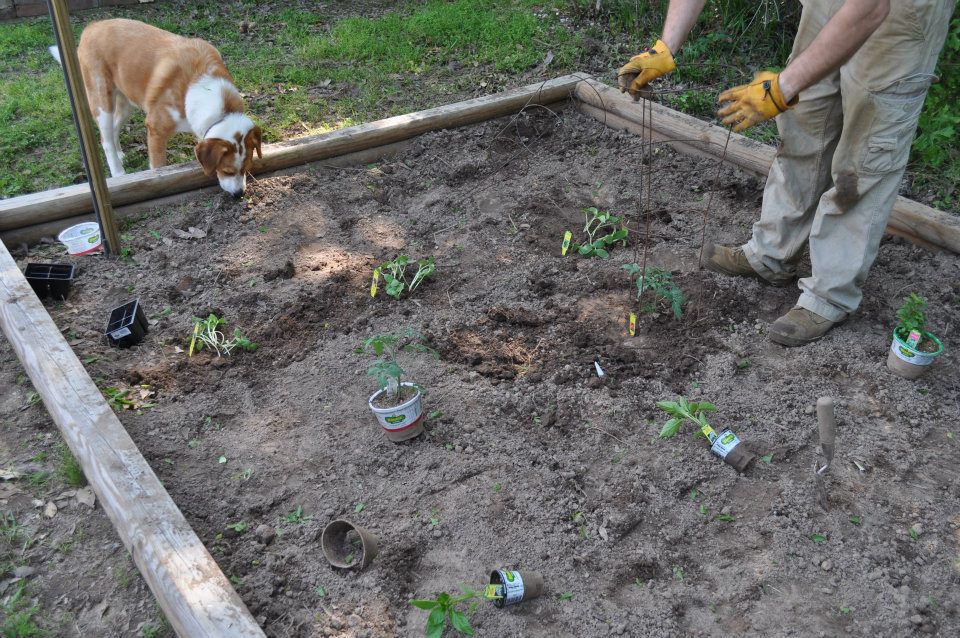
Hart decided to serve as a manager and oversee the project

The very next day, my National Weather Service weather alert radio started blaring that we should expect strong storms that night. I stood in the back door of my house and watched it hail on my new garden. Luckily, the hailstones never got bigger than pea size. This would be the predictable unpredictability I spoke of earlier. Unbelievably the next day it happened AGAIN. Only this time, with Donna's help, I was prepared.


I’ve lived in Shreveport for a half a decade and never ONCE did it hail, only to have it hail TWICE in a forty-eight hour period – which just happened to be the first forty-eight hours after I planted my garden. Not a good start, I thought. My only consolation was that my life did not depend on the vegetables growing in my garden.

Then the skies cleared and my little garden took root. The cucumbers, as it turns out, needed to be planted about 300 feet apart, preferably in the middle of a soccer field or professional sports stadium. (I’m exaggerating, but cucumbers definitely need some space…way more than was suggested on the package.) It seems silly but the first time I noticed a fruit actually growing, I was ecstatic. I preach a lot on this theme but it’s worth repeating. We grow up in a society where things like cucumbers grow on Aisle 10 at the supermarket. When you actually see one growing and pull it straight from the ground, you have a little “ah-ha!” moment. It was the same feeling I had when I raised chickens in Waring, Texas. The first time I went to the coop, grabbed an egg and then ate it for breakfast, I felt surprisingly strong sense of empowerment.

Watermelon and cucumber on the left, tomatoes in the middle, and bell peppers on the right

My current challenge, as my garden continues to grow, is to know when to harvest – especially the vegetables like potatoes that are underground. About a week ago, I sacrificed one of my potato plants so I could see what was going on underground. There was one small potato (which I ended up eating so I wasn’t a total loss.) But now I know how far along the potato is at one month. I sacrificed one plant to know what was going on with the other nineteen.

As an aside, I should emphasize here that in any learning process its okay to make mistakes and ask questions. One of the most important lessons I learned about this is with horses. Someone told me once (and I can’t remember who so forgive me whoever you are!) that when you’re learning to ride a horse the first thing to know is this: you WILL fall off. So stop worrying about that part. The second part is that AFTER you fall off you get back on. I saw a lot of novice riders at Wind River Ranch that were so preoccupied with worrying about falling off that they forgot to have fun and learn. That spirit applies to any endeavor and it applies to gardening as well. I’m the first to admit I don’t know what I’m doing, but I’m also the first to ask questions and glean information from ANY source I can find. Donna’s brother-in-law Jonathan Patin had some suggestions for my tomatoes. My neighbors Ginger and Jason shared some of their gardening experiences, and of course there’s the seemingly infinite source of information called the Internet. The knowledge is everywhere and it’s your responsibility to assemble it into a working format that you can then apply to your endeavor, be it gardening or whatever.

About a month ago, I decided to pick the first fruit from my garden. We called it the “Ceremonial First Fruit” which is an ancient tradition that I started. I picked the biggest, plumpest strawberry on the plant, and then marched it into the house as Donna snapped pictures. 


Understanding the immense and powerful symbolism of the Ceremonial First Fruit, I cut it two and served it up on two plates. We put a little sugar on that strawberry and ate it in one bite. Everyone knows that any food you grow yourself automatically tastes a little better.


The garden is an ongoing project. I tend it daily weeding it and watering it, keeping a watchful eye on my field. Soon I believe we will have a big potato harvest as well as tomatoes and cucumbers. My goal is to eat a whole meal out of my garden. Stay tuned for more garden updates and more naturalist adventures! 

Tuesday, May 22, 2012

Exploring the Night Sky - Polaris, Inclinometers, and a Really Big Dipper!


An important part of being a naturalist is observing the night sky. While you don’t have to be an astronomer, it is good to know a few basics. But there’s more to knowing constellations than just impressing girls at the next back yard barbeque. Knowing the sky can assist you in navigation down here on the ground, and just might end up saving your life.

The first and most basic skill any North American naturalist should have is the ability to find the North Star, otherwise known as Polaris. In an age of electronically mediated navigation, knowing where to find the North Star is the most basic (and easiest) direction finding technique that requires ZERO technology. The concept is very simple. First you want to find the Big Dipper in the northern sky. (It’s pretty easy- it looks like a big dipper.) Find the two stars that form the right side of the dipper – or what would be the “front” of the dipper were you looking at it three dimensionally. If you draw a line through those two stars pointing up, that line will pass right through Polaris, which is the brightest star in the immediate area.  I found a great picture that illustrates this. (I would credit the graphic design appropriately but I have no idea who did it!)


This image might seem familiar to those of you from Alaska. If you're not from Alaska, this will be a very useful bit of trivia somewhere down the road. This Big Dipper/Polaris image is also the exact design of the Alaskan flag seen here: 


This the tough part. That big bright star in the corner of both of these images is the North Star..which is NORTH. So... if you're facing Polaris, SOUTH is behind you, EAST is to your right and WEST is to your left. 


What most people may not realize - and why the North Star is such a trustworthy guide - is that it is a fixed point in the sky. The entire night sky rotates around the North Star. If you've ever seen a time lapse photo of the night sky, you will clearly see that all the other stars are "moving" but good ol' Polaris is stuck right in the middle. That being said, depending on where you are on the continent, sometimes the Big Dipper will dip below the horizon. If you can't find it, don't panic! It will come back around eventually and you will be able to pinpoint North. 


Now here’s another interesting part. If you happen to own an inclinometer or sextant, you can very accurately measure the distance between Polaris and the horizon. That measurement is your latitude – or distance in degrees above the equator. For example, here in Shreveport, Louisiana, the latitude is 32.4681° N. That means that the city of Shreveport is a little over 32 degrees above the equator on the map. And, were you to stand in my back yard and measure the distance between Polaris and the assumed horizon, it will be 32.4681°. Since most people don’t own an inclinometer or sextant, just for fun you can eyeball it and see if the numbers are close. 


As a very nerdy addendum, next time you take a long trip north or south, pay attention to the location of the North Star. In 2001, I went on a very long road trip to Eastport, Maine, with my friend Janet Owen. On a random highway in the thick woods north of Perry, Maine, we stumbled across this unbelievable marker on the side of the highway. (Please note that the early summer season in Maine was MUCH cooler than we expected and we had to borrow these ridiculous jackets from a dusty chifforobe owned by my friend D.J. Sutherland in Eastport.)


We were halfway between the Equator and the North Pole! Now applying what we've learned here today, had I observed the night sky on this journey and made a measurement with an inclinometer, the North Star would have been 45°above the horizon. Conversely, two weeks before this trip, Janet and I had both been on a cruise with a jazz band from our college, Angelo State University. On the cruise, we traveled all the way to Playa del Carmen, Mexico, which has a latitude of 20.6167° N. While were on the cruise ship, I actually did observe Polaris because the stars on the open ocean were so incredibly bright. Predictably, Polaris had sunk toward the horizon. The farther south you travel, the more the North Star moves closer and closer to the horizon. Had we gone all the way to the Equator, the North star would have been level with the horizon. Furthermore, I've never been to the North Pole, but if I ever get there I'm gonna look straight up because Polaris will be directly above my head - or 90° - which means the latitude of the North Pole is 90.0000° N. The longitude? 0.0000° W. 


Why does all this matter? In our modern world to average people standing in their back yard it doesn’t matter much. However, were you ever stranded at sea or lost in an incredibly remote area after a plane crash, being able to pinpoint your latitude might assist rescuers in finding you, or even assist you in saving yourself. (If you think this sounds like an outrageous possibility please take a second to read this article. It took these plane crash survivors two months to figure out where exactly they were when they crashed.) 

http://en.wikipedia.org/wiki/Uruguayan_Air_Force_Flight_571

However, what I would argue is more important than determining latitude is simply knowing how to find the North Star. This is very basic, but if you were lost somewhere and you knew there was a town or river north of your location, being able to site the North Star would show you the way. This seems elementary, but sometimes when you’re under duress even the simplest things can become complicated.

I heard a poem once about how cowboys driving cattle on the open plains would point the tongue of their chuck wagon toward the North Star at night. That way in the morning when they awoke and the whole Great Plains landscape looked exactly the same, all they had to do was look at the wagon tongue and know which way to drive the cattle.

It sounds silly, but under any circumstance where you were lost, step #1 is to find which way is North – then by default you gain your bearings with every other direction. In modern society, we are so far separated from the stars and their importance that people tend to take them for granted. For thousands of years, sailors used only the stars to navigate across open oceans, and once the chronometer and sextant were invented, sailors could pinpoint their exact location on the face of the earth to within a mind boggling two or three miles – with no computers, no satellites, and no GPS!

Once people understand that ALL navigational principles are derived from the stars above us, they will see why it’s important to know at least the most basic astral navigational aids. Once you’ve learned about the Big Dipper, Polaris, and how they relate to latitude you can graduate onto bigger things - like next week’s blog about determining your longitude with a chronometer!

Wednesday, May 16, 2012

Mimosa Trees and Train Dodging - All in a Day's Work


Tuesday’s adventure took me back to the same canal north of Wildwood Park here in Shreveport. Originally, Donna was going to drop me and Hart off at the end of Pickwick Street, where the canal opens into a much larger canal, but the day’s rainfall had filled the canal and it didn’t appear safe. So we resorted to Plan B and Donna dropped us off at the same canal north of Wildwood Park.

Because it had rained all day, the canal was a mess. Everything was muddy, and all the grass was heavy with rain. It wasn’t long before Hart and I were both soaking wet. We traipsed along the south side of the canal with no particular agenda. What I like about rainy, cool days is that snakes tend to be less active. Because they are ectothermic, you’re not likely to find them just hanging out on a cool day. More than likely they’re holed up somewhere staying warm. Of course “cool” is a relative term. The temperature was in the mid-70s and it was very humid. After hiking a bit, I felt hot. But snakes derive all of their warmth from external sources, so if it has been raining all day with no sun a snake would probably be inclined to stay home. 

We came across an area of grass that looked like it had been trampled and that something had slept or rested there. I have never seen a deer anywhere in the city so I wasn’t sure what caused this. Either this was a fluke, or some large creature had definitely flattened this grass. I’m really not sure.


As we trekked west I noticed some Mimosa trees, otherwise known as Albizia julibrissin. Mimosas are curious little trees. They have a pink flower and if you pay attention they are everywhere in North Louisiana. They flourish especially along canals and waterways because the seeds travel by water. They also flourish along developed areas because they are hardy plants that re-sprout easily when chopped or cut. (Traveling along Loop 3132 here in Shreveport you will see dozens and dozens of these ornamental trees.) 


The scientific community considers Mimosa trees a nuisance – mainly because they spread like wildfire and steal nutrients from other more desirable trees. The Center for Aquatic and Invasive Plants at The University of Florida shares this information about the much maligned Albizia julibrissin.

Originally from China, Mimosa or Silk tree was introduced to the United States in 1745 and cultivated since the 18th century primarily for use as an ornamental. Mimosa remains a popular ornamental because of its fragrant and showy flowers. Due to its ability to grow and reproduce along roadways and disturbed areas, and its tendency to readily establish after escaping from cultivation, mimosa is considered a Category II invasive by Florida’s Exotic Pest Plant Council. 


        Mimosa is a deciduous, small to medium-sized tree that can grow 20 to 40 feet tall. It is a member of the legume (Fabaceae) plant family and is capable of fixing nitrogen. The bark is light brown and smooth while young stems are lime green in color, turning light brown and covered with lenticels. Leaves are alternately arranged and bipinnately compound (6 to 20 inches long), having 20 to 60 leaflets per branch. The leaf arrangement gives mimosa a fern-like or feathery appearance. Mimosa flowering occurs from May through July. Pom-pomesque flowers are borne in terminal clusters at the base of the current year’s twigs. The flowers are fragrant and pink in color, about 1½ inches long. Fruits are flat and in pods, a characteristic of many legumes. Pods are straw-colored and 6 inches long containing 5 to 10 light brown oval-shaped seeds about ½ inch in length. Pods typically persist on the plant through the winter months.
Mimosa reproduces both vegetatively and by seed. Seeds require scarification in order to germinate. This characteristic allows the seed to remain dormant for many years. Normally seeds are dispersed in close proximity of the parent plant; however, seeds can also be dispersed by water. Wildlife may also contribute to the spread of mimosa through the ingestion and excretion of the seeds. Vegetative reproduction occurs when trees are cut back, causing quick resprouting and regrowth.

The reason Mimosa trees are so invasive is that whether you chop
them, cut them, burn them, bulldoze them, or otherwise destroy 
them, the seeds stay behind. Then the birds digest the seeds and 
deposit them elsewhere or the seeds regrow right where they fell. 
They are beautiful trees, but if you look around you start to realize 
just how invasive they are.

Moving on I decided it was time to bisect Wildwood Park. This area of North Louisiana is thick with vegetation. It makes you wonder how they ever settled this area in the first place. As you can see from the picture, Wildwood Park is no exception. For at least 300 yards, you couldn’t even see into the forest. 

Eventually I just picked a spot and nosed my way through. The forest was dark, wet, and foreboding and probably isn’t anywhere you would want to be stuck after dark. But it brings up an important topic. When I entered the park, it was already after 7 pm. There was no sunlight and no way to visually gauge how much daylight I had left. Luckily, I knew what time the sun set and I was wearing a watch. But as I observed the forest as the light faded I had this thought: were I an inexperienced outdoorsman and I was lost, I could easily see how you could be gripped with fear as you suddenly realized without warning that the gray light was dimming.

One of my favorite shows to watch is “I Shouldn’t Be Alive,” or as I like to call it, “How One Incredibly Stupid Decision Almost Cost Me My Life.” Almost always, in the first five minutes of the show, the main character makes some decision that is so incredibly stupid it makes me want to throw my shoe at the television. All that to say, knowing something as simple as what time the sun sets would allow you to find a suitable camp and make a fire before – in a panic – you have to frantically scramble to do all that before dark settles in. Sometimes one simple piece of knowledge makes all the difference in the world. I always carry with me some potable water, a knife, and usually small snack. If I’m going into more remote areas, I take a small pack with a handful of survival materials. Short of being dropped off in Antarctica, I’m pretty confident of my ability to camp on the fly – or at least successfully enough to survive until help arrives. It constantly amazes me how often people wander off into potentially dangerous environments with only a cell phone because they naively think “I will just call for help.” Then their phone dies.

Enough preaching! Where was I? 

Hart and I made our way through the thick vegetation and paused momentarily so Hart could cool off in this puddle of water. 


I splashed my face as well. As dirty as the water looks, it was more refreshing than the sweat I had pouring down my face. The vegetation was so thick that while I was crouched by the water I didn’t realize we were a mere twenty yards from the train track! A train rumbled by and I immediately had my bearings.

We made our way onto the track. Laughably I found this right handed railroad glove on the track that some worker had lost.


As it turns out, it was a near match to a left handed glove I found on the track last winter. (One is insulated and one isn't..but darn close!) After this little discovery, I called Donna and made plans with her to pick us up at Hyde Park, which was about a half mile east on the railroad track. 

I was walking along with Hart daydreaming about who knows what when I just happened to glance up and see the headlight of a train! There are no road crossings on this stretch of train track so I of course didn’t hear his horn blow! I looked around and realized in a very “Stand by Me” moment that Hart and I had nowhere to go! On the left was a drainage ditch full of mucky water and on the left was thick vines and vegetation. Realizing I had to make a choice I dove into the vegetation. Suprisingly, Hart stayed on the track and looked at me like I was crazy. I yelled for him to come. Of course he took his own sweet time so I scrambled back up to the track and pulled Hart down the embankment with me. I had just enough time to pull out my phone and film the train as it rumbled past us!


After that little episode we met up with Donna at Hyde Park. We were sweaty, muddy, and stinky – all signs of a successful nature adventure!


Saturday, May 12, 2012

Exploring an Urban Jungle: Egrets, Snakes, and Liquid Cocaine

Saturday afternoon I set out on another adventure. I’ve gotten a little spoiled not working during the day because when weekends roll around I get frustrated at how crowded parks can be. Sometimes I joke with Donna and say, “The only problem with parks is that they are open to the public.”

With that in mind, I set out on an adventure in an area that I discovered about a year ago. In South Shreveport is a park called Wildwood Park. I found it one day while looking at a map and noticed a giant green area very near my house. Of course I got excited and started to figure out how to get there. Very quickly I figured out there were no roads to Wildwood Park. Or as they say, “You can’t get there from here.”

Thinking it odd I got in my car and investigated. As it turns out, Wildwood Park is the home of SPAR, the Shreveport Parks and Recreation department. Their headquarters is at one end of the giant park, totally fenced off and accessible from Jewella Ave. The park, in its entirety is 75 acres, if you can believe, and only a few on one end are used for the SPAR headquarters. There are no roads, trails, or access points to the rest of the park.

That’s where I come in. I spent the winter exploring Wildwood Park. I traversed every square inch of it. There isn't one single improvement to the park. There aren’t even fences. It’s like my own private old-growth forest very near my house. And, as it turns out, the railroad tracks that run by my house go right by Wildwood Park.

Needless to say I’ve spent a lot of time there. A large drainage canal borders the north side of the park. It used to be a creek, once upon a time, but now it’s hemmed in by concrete. It’s falling apart in places, which is a reminder of one of my many sayings: “Nature was here when we got here, and it will be here when we’re gone.”

Three weeks ago I discovered some wild berries of some kind, which were edible at the edge of the canal. How do I know this? I tasted one and it wasn’t bitter, and then I ate about ten more and didn’t die. It’s not very scientific but it’s a surprisingly effective method.


My goal on this trip was to bring back a Ziploc bag full of these berries. Unfortunately when I got there, the birds had stripped the vine clean and I only found one berry. Disappointed, but undeterred, I continued on my journey. 

Almost immediately I came across something that was definitely a first in my outdoor adventures.


"What is this?" you’re probably wondering. I was wondering the same thing. It’s obviously a condom but its contents were a mystery.  I googled it on my phone and almost immediately I knew what it was.

Liquid cocaine.

At least I think it was. Luckily I have not lived a lifestyle nor do I have a job that would lend itself to immediate visual identification of a controlled substance. I did some more research on my phone sitting right there in the canal and I was pretty sure I was looking at liquid cocaine. If I'm wrong, please someone who's in the know educate me! I tried to figure out what it was worth but the best I could come up with was an estimated street value of “five to ten years in prison.”

Later I called the police and reported it at the behest of a friend of mine who is a cop in another town. Mostly I wanted to keep it out of the hands of any kids, seeing as there were houses all along the north side of the canal.  I debated on whether or not to include this in this post, but then it occurred to me that cocaine is in fact a natural substance even if it is packaged in a condom for distribution! See, kids? Nature is involved in all kinds of crazy things! 

We continued on our adventure, retracing our steps and exploring the canal to the east. In this direction, the canal was considerably less structured and it started to become difficult to traverse. I had already seen one snake in this canal last week, so I was on high alert as Hart and I made our way along. I made a very rookie mistake and wore the wrong boots.  After a while I gave up trying to keep my feet dry and just waded through the water. When you’re in an urban jungle, everything looks like a snake: twigs, bicycle tire tubes, ropes, springs. It’s very unnerving. At one point, Hart stepped on a twig that jumped up and tapped him on the leg which scared him so bad he went flying into the air. The action was so sudden I jumped as well and let loose of a string of inappropriate words before we both realized it was just a twig. Needless to say after our jungle expedition my nerves were a little frayed.

I always feel like Indiana Jones when I’m on little expeditions like this – like anything could happen. To add to the effect, I’m traipsing through unknown waters waiting for who knows what to surprise me. Maybe that’s why I enjoy these trips so much. It’s kind of rush. It has been my entire life.

Continuing on I was reminded too of how our urban centers simply mask nature. I found two great examples: trees which should look familiar to you if you read my earlier blog posts. 


It’s two sycamore trees! Notice how one of them has grown through and then over concrete. The main difference between man made structures and nature is that mankind’s structures have to be maintained. Nature simply does not. It’s an interesting little world in this canal to see that nature is obviously winning the battle.

The last adventure of the day was to be found at the sidewalk’s end, so to speak. We reached a point where the structure of the canal had totally failed creating a pretty cool waterfall. As we approached it a giant heron or egret who was hidden out of sight below the waterfall launched him self into the air, squawking at the same time. It of course scared the living bejeesus out of me. I didn't get a good look as to identify it because it scared me so bad. 

Then I was in for one more surprise. (*Please note that in the video I incorrectly called the bird a "stork" because that was the first word that popped into my head when describing a giant bird.*)


All of these adventurers happened within a fifteen minute walk of my house right in the middle of South Shreveport, which is a great reminder that nature adventures can happen anywhere! Here's a few final photos from our afternoon journey. 


Notice the concrete is crumbling, creating small chutes of water.


It's an urban jungle out there! 


Bamboo growing wild along the canal.


Rule #1: Don't be afraid to get dirty! 


A good omen on the return walk: a hawk perched on the power pole watching me make my way home. He's hard to see, but he's there. I've seen this same bird in Wildwood Park. I consider him a neighbor!


Until the next adventure!